
Industrial acoustic and luminous signaling: informing, warning, guiding and coordinating processes
Industrial acoustic and luminous signaling: informing, warning, guiding and coordinating processes
In an industrial plant, every second counts. A machine that stops, a process that ends, a line that changes format or an incident that requires intervention must be communicated quickly, clearly and unequivocally. In this context, industrial acoustic and luminous signaling becomes much more than an emergency resource: it is an operational tool to understand what is happening within a production process.
In complex industrial environments, where machines, operators, robots, electrical panels, automated systems and areas with specific requirements coexist, industrial signaling systems help reduce ambiguities and improve coordination. A beacon, a signaling column or an acoustic warning device can indicate the status of a team, confirm an action, warn of a deviation or guide a work sequence.
Signaling as a plant operating language
Industrial signaling is not only used to warn of a risk. It also allows for informing, warning, guiding, confirming and coordinating actions within a facility. This difference is key because in many cases, the signal does not communicate an emergency, but rather information necessary to maintain the workflow.
For example, a light column can indicate whether a machine is running, stopped, in maintenance mode or in an error situation. An acoustic warning device can reinforce an alarm when the environment has a high sound level. An LED light on a panel can offer the operator a clear reference to the status of a piece of equipment. At IES SOLER we have panel lights designed for automation and installation in electrical panels, which provide a visible reference to the status of the equipment and contribute to improving efficiency and productivity.
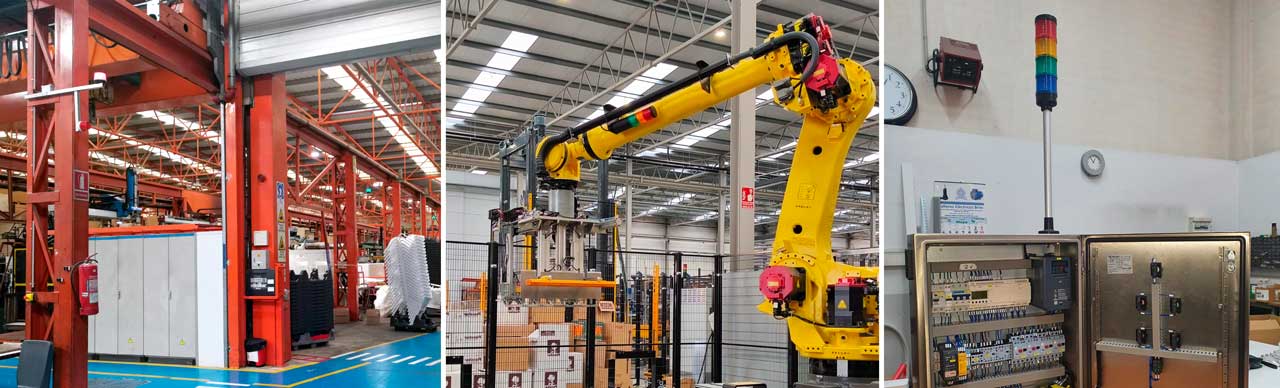
Applications of acoustic and luminous industrial signaling in machines, lines and processes
In a production line, acoustic and luminous signaling can be applied to many everyday situations. It can indicate a correct or incorrect end of a cycle, a programmed stop, a format change, a quality incident or the need for intervention by an operator. In these cases, they allow immediate messages to be transmitted within the plant, especially when it is necessary to coordinate operators, automated equipment and production phases.
It is also useful in sequential processes, such as assembly systems, component preparation or pick-to-light flows, where visual signals help guide the order of operations. In these cases, signaling does not act only as an alert, but as a direct support for the execution of the process.
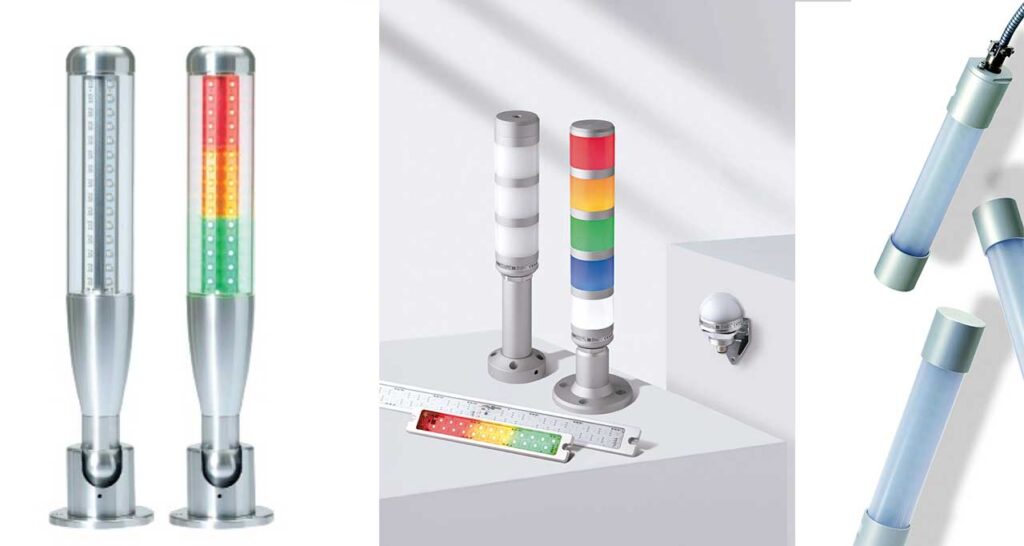
Signaling columns, together with acoustic warning devices and luminous beacons, are a good example of this function. At IES SOLER we offer modular LED columns for warnings or alarms, with or without sound, available in different formats and diameters, and also with certified options for classified areas. This type of solution allows the signal to be adapted to the reality of each installation: an automated line, an independent machine, an assembly area or a critical control point.
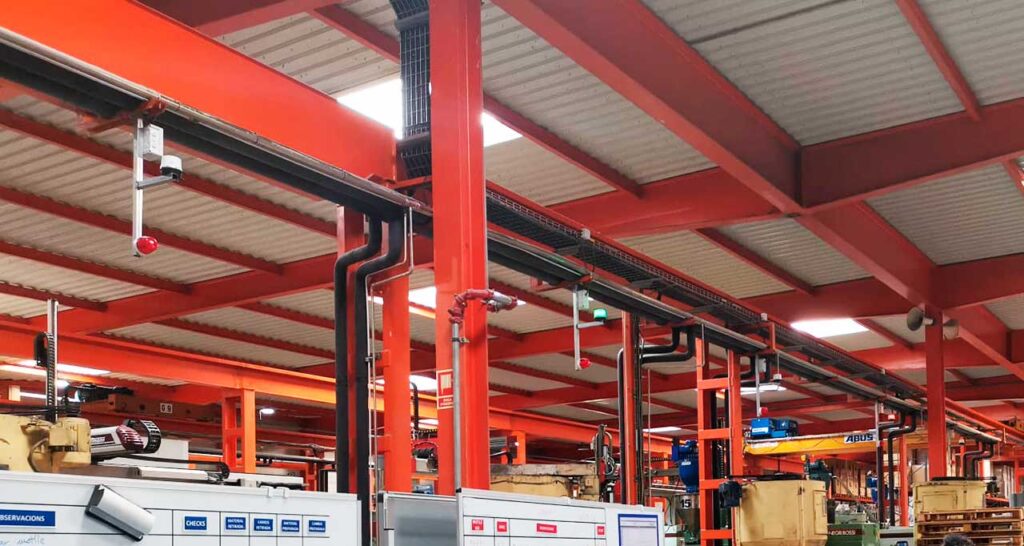
Integration with automation and connected industry
Current industrial signaling should no longer be understood as a set of isolated “lights and sirens”. In many environments, these devices are part of automation systems and can be integrated with PLC, SCADA, industrial networks or monitoring systems.
In current production environments, acoustic and luminous industrial signaling can be integrated within industrial automation systems, PLC, industrial networks, monitoring systems or SCADA systems. This integration allows acoustic and luminous devices to be part of the process logic and communicate the status of machines, lines and operations in real time.
Along these lines, IES SOLER has Industry 4.0 solutions that allow real-time monitoring of machines, equipment and workplaces, and managing devices such as columns or RGB sounders from the control room remotely.
Signaling for demanding industrial environments
Not all industrial environments have the same needs. A chemical plant, a petrochemical facility, a food line, an ATEX zone, a naval environment or an airport infrastructure may require devices with specific characteristics of resistance, tightness, visibility or certification.
In areas with explosive atmospheres, for example, at IES SOLER we offer explosion-proof acoustic and/or luminous signaling devices, intended for sectors where explosive atmospheres can form due to the presence of combustible gas or dust, such as refineries, chemical, pharmaceutical or food industries.
In naval or heavy industry environments, robustness and corrosion resistance are decisive. We group signaling devices designed for the marine sector, with high durability and good sealing, suitable for boats, the steel industry and applications in outdoor plants.
There are also very specific needs in air and maritime signaling. At IES SOLER we have obstruction beacons for air obstacles according to ICAO/FAA regulations, applicable to chimneys, cranes, wind turbines, buildings, helidecks or communications antennas.
The Safety Division of IES SOLER
At the Industrial Safety Division of IES SOLER we work with acoustic and luminous signaling solutions aimed at improving communication within industrial environments. Our catalog includes acoustic and/or luminous warning devices, beacons, signaling columns, sirens, panel lights, ATEX solutions, signaling adaptable to any type of sector.
These devices help to make visible and audible the information that a plant needs to operate in the most efficient way possible.
In short, acoustic and luminous industrial signaling is a key piece in communication within these environments. When it is well selected and integrated within production processes, it not only helps to warn, but also to order, coordinate and optimize them in increasingly automated and demanding production ecosystems.

